We have already shown here fans said
"au rectangle" (see for instance our
"piggy fan").
There would certainly be more
to say about this matter: it is not our
purpose here,
since we only want
to share our questions about
an item which recently entered our collection.
The more our fans knowledge increases,
the more alas our
uncertainties also grow.
This is why we constantly ask our
visitors to kindly
tell us our mistakes
... and why
we ask these "Questions d'Eventails" with the hope (not
always disappointed)
to get answers and sometimes enrich
the "Monographs"
section of the site.
In order to tease your
curiosity, we
shall start with the face
down of this fan leaf "mise
au rectangle". On
the back of an important frame,
obviously specially built in the nineteenth century,
we at first removed the
old brown coverage paper. Under this paper,
we have found some remains of a previous
backing, and a large rectangle of old
whitish coating. The
wood panel, with its
beveled edge at the rear,
appears significantly
older than the frame. After
this first phase of
discovery,
we note the presence
of a hole which seems
to have once served
to suspend the wooden panel.
We also question the
whitish
coating, probably
a trace of a previous framing,
but maybe also of the presence -that we have seen on
another occasion-,
and the disappearance of the original merchant's business
card.

 |
The
importance of the frame
is surprising.
But the real surprise,
for somebody accustomed to fans
and fan leaves "set
to rectangle", is
the small size of the
"rectangle",
and even more of the leaf itself.
Indeed, the panel
measures 28.4 x
15.1 cm (11.18 x 5.94 inches) and the
visible painting is
some 28.1 x 14 cm (11,06 x 5,51 '), with
a slight overhang on
top of the leaf,
hidden by the frame.
Thus the fan
leaf itself has a width of only
9 cm (3.54 ') and the
total height of the
potential fan scarcely
exceeds 14.7 cm (5.79 ').
|
|
As we consider this
item,
we find that the leaf
seems to be made of skin
(thin, but less than the
beautiful Italian
"cabretilles").
It is entirely
gouache and gold painted. It has been applied on a
coated plank of wood and, as
usual, the paint has been
extended in the corners and on the
part of the "gorge".
The bodycolour used for these extensions
seems of lower quality than on the fan leaf itself.
This one has, surrounding the wide central cartel narrow borders with leafy gold
motifs, quite
common in the
last third of the seventeenth century. But these borders,
still bright and vivid in the non-enlarged
parts are dull
on the gorge part and at the
top of the leaf, for they probably have been re-painted when setting the leaf to the rectangle. We
also find that flowers
added in the corners are
less vivid, and their
paint is peeling. Perhaps some
conservation work to undertake?
Here is the
object as it appears
once out of the frame, and without the old and scratched
thick glass
which till now has protected it.
(note below
the hole that was probably once
used to suspend the
panel)
: Histoire
de la mode en France. La toilette des femmes depuis l'époque
gallo-romaine jusqu'à nos jours, par Augustin Challamel,...
Auteur : Challamel, Augustin (1819-1894)
Éditeur : Bibliothèque du "Magasin des demoiselles" (Paris)
Date d'édition : 1875
Remember:
Copying pictures is strictly prohibited without our permission.
It is
useless to dwell on
the description of the leaf, full of life and with still vibrant colours.
Various questions arise, that
we shall submit to our
visitors, whether fans specialists or
not. We will give
our first impression, asking our
interlocutors not to hesitate to contradict us. We
just want to begin
the discussion.
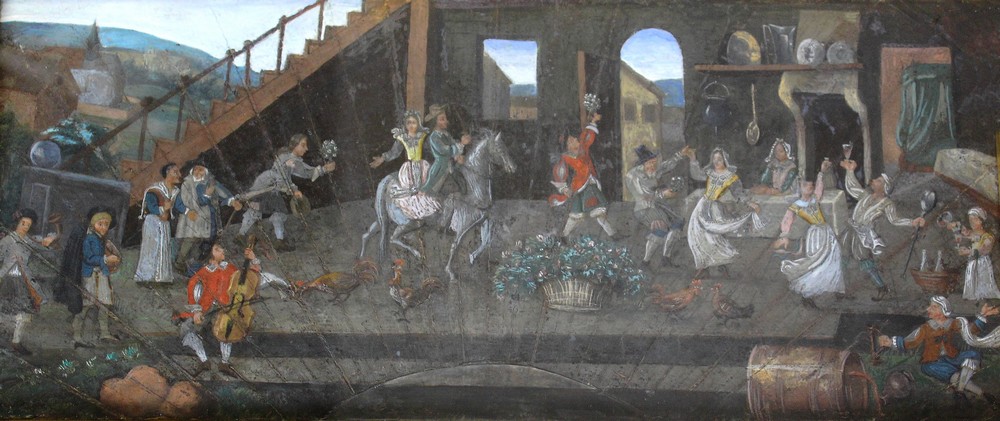
1) What does this leaf show off ?
This is clearly a festive light meal on a farm or country house. The fire is
burning, the table is set with a beautiful white tablecloth, nice
plates and beautiful glasses and decanters have been taken out from the
cupboards. The rich frame of flowers on a gold background nicely
complements this festival scene, enhanced by the violinist who stands
in the door of the house and the two musicians who are sitting in the
foreground, playing the flute (?) and guitar (?) .
Let us go
further and look at the details under the microscope ... or on a
computer screen! We increase the scope, neglecting the fireplace and
the servant who brings a nice red fruit tart
(so it seems). Also red, and signs of nobility, the heels, the garter
and the feather on the black hat of the elegant young man, like his neighbour headgear (cap?).
But who is this man? Is it a noble member of Parliament? Who is the
woman with the blue "pointe d'estopmac" that he seems to hand
point? There is surely something to celebrate. Does the man in red
jacket raise his glass in honor of the young woman sitting at the
table? Are the older man and woman at the
other end, two peasants parents of the young woman whom the lords pay a
visit on the occasion of marriage or engagement? But is it common in
such circumstances, to have a dog dancing?
2) When was this leaf made?
If we assume that the realization of the leaft is contemporary with the depicted scene , reviewing costumes should help somewhat, at least those of the most prominent characters, because we know that the rural
costume knew less variations: the most humble characters are no
different from those shown by the Le Nain brothers before 1650. Yet
here, the hairdresses of the man and woman, with long hair, but
relatively flat on top are signs we are before the fashion of
high wigs for men and "à la Fontange" or even "Hurluberlu" hairstyles for ladies. The lady's red hat (?) surprises, though.
So our first impulse is to date the scene (and the leaf?) ca. 1670, which is also consistent with the young women large pearls necklace. But it is quite possible that we are wrong!
3) Is it possible to source this leaf?

|
Fans connoisseurs know
that: it is rare that these objects are truly original. They reproduce
often, and genrally adapt, works of art and, especially, engravings.
Here we have a priori no identified source, but we rely on our visitors
to find it or them!
Simply note that as for the
elderly couple -especially the man-, we find some analogy with the
works of Jacques Stella (1596-1657), particularly in the Pastorales series engraved by his niece Claudine Bouzonnet-Stella (1641-1697).
On the left you can see - thanks to the Bibliothèques Municipales
de Lyon, and their recomended electronic online database- a close-up from La
veillée à la ferme pendant l'hiver, by Claudine
Bouzonnet-Stella after Jacques Stella, Paris,
Galleries du
Louvre (estampe en taille-douce, eau-forte et burin, 24,3 x
31,2
cm)
But "comparaison n'est pas raison" (comparisons are misleading).
|
4) Why is this leaf so small?
We own some leaves "au rectangle"
and have seen a lot. Some of these are small like the one we show
below but one quickly realizes that this is because only the central
scene of the fan leaf has been preserved.
In the case of leaf we are studying here, the leaf is complete, and the dimensions are really restricted, as you can see.
14,7 cm = 5.79 '  9 cm = 3.54 ' 9 cm = 3.54 '
For a better understanding... I have put this tiny
fan leaf, with its huge 19th century frame on a quite contemporary
leaf, this one with an old "à la Berain" frame. I think that this
picture says all.
Therefore, if this leaf corresponds to a fan which has been
mounted, or should have been, what could be this fan? A "normal"
fan? A young girl's one? A fashion doll fan?
This has leaded me to entertain myself by building an "éventail
au rectangle" mixing our two items. And I think that this
marriage is not so bad a match. Just have a look at the picture below.
Dear friends and visitors, from
YOU I expect the answer to this question as well as to the
previous ones, reasoned of course and if possible supported by
photographs. We will gladly publish them, as far as they appear likely
to advance discussion and knowledge.
P.H.B. January 2013
In June 2013, the Italian
collector Maita Golfieri, whose hand fans can be admired on her website
"I miei Ventagli" (http://www.imieiventagli.it/) pointed out a fan leaf
she owns and dates back to 1620 (see her page "Domenichino"). She
thinks there could be some relations between our two fan leaves, which
are nearly the same size ; albeit the differences of subjects
(mythological versus country life), of framing and of datation (but in
this field we may be wrong).
This has led me to entertain myself by building
an "éventail au rectangle" mixing our two items. And I think that
this marriage is not so bad a match. Just have a look at the picture
below.
So what..? I am only asking a question... and waiting for your answers, dear visitors!
Thank you for writing (on our Home Page), and do not forgot to go and see our other
questions!
|