Here is a hand fan that seems ordinary, and which is also in poor
condition. If you look closely at the photo, you will see that one of
the guards has been repaired and that a missing stick has been replaced
by a photo, so that the view is not too disturbed and that the fan
closes without too much trouble. Moreover, we will not even dare to
show you the back, dirty and torn. We suspect a previous owner of
having glued the object to display it in a frame. What a detestable
practice! And yet, the goal was to preserve this object, for a reason
that was perhaps not only decorative.

But first, let's describe it. It's a 12 sticks fan (plus two guards)
measuring 27.7 cm (11.0 in) with a 12.7 cm (5 in) leaf. We may suppose
it dates from the 1780's. French or English?
The gouache- and gilded skin leaf is mounted "à l'anglaise" (it is a single leaf
and you can see the ribs on
the verso).). This reverse
features flowers and a branch. On the front, in a central cartouche, we
see a shepherd playing the flute for his shepherdess, who we can assume
is his wife, since next to them a little boy is playing with a
garlanded sheep. Around it, we see attractive garlands of flowers, and
laterally, in rinceaux, a
musical trophy on the right and a bird, probably exotic, on the left.
All this is charming, as the enlargement below shows.
But it is probably not this pleasant but banal scene that justified the
preservation of this broken fan (Do not say "brisé", which in French and in the
case of fans can be a "false friend"). It is the decorations of the
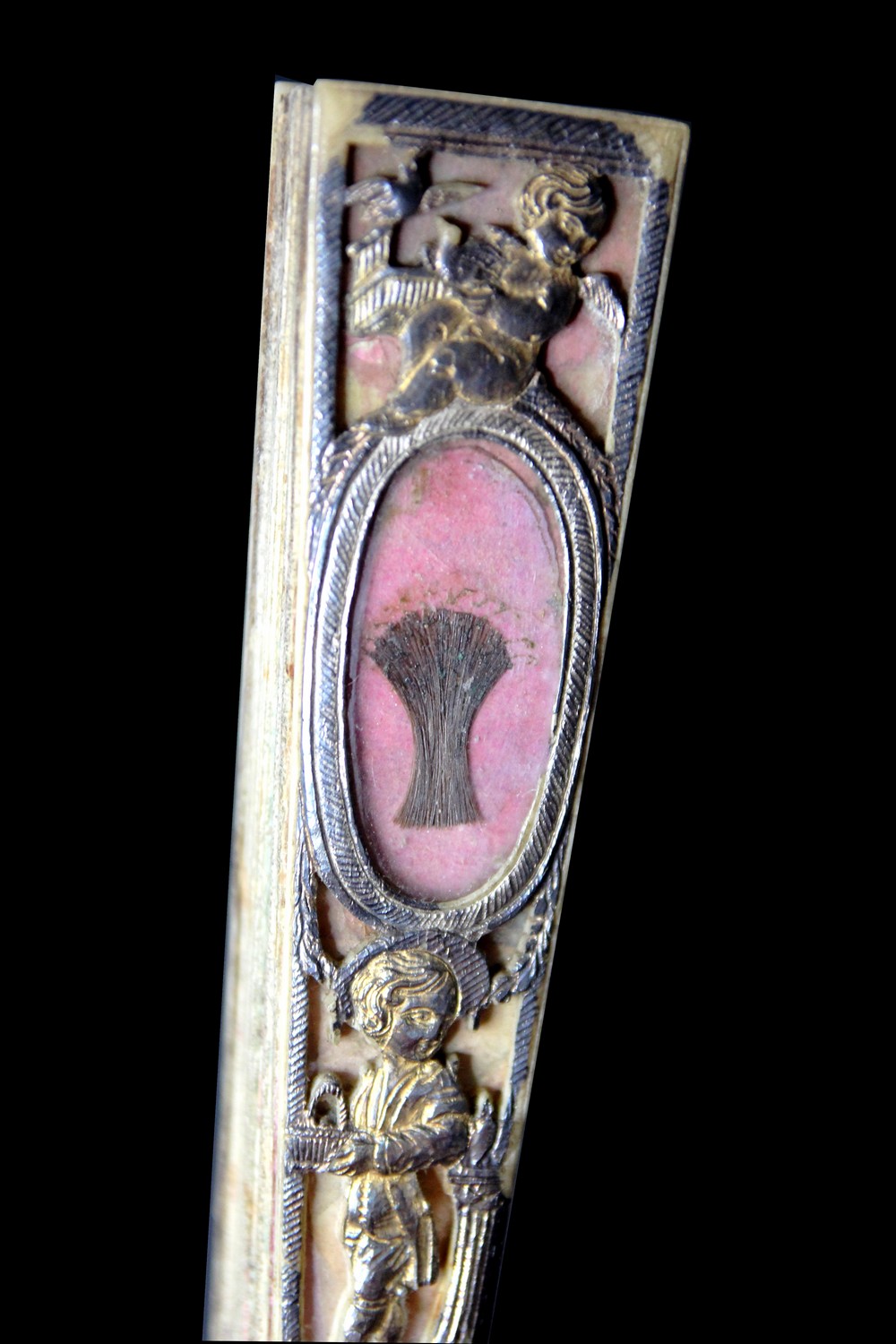
guards! Indeed, if the pleasant monture
(in pierced, engraved, sculpted and gilded mother-of-pearl) has on the gorge a central cartouche with
gallant characters and also the usual flowers or birds, these guards
present under glass unusual motifs of sheaves of wheat. If such images
can match the pastoral character of the leaf, it is the material used
that can surprise: in fact, it is clearly hair!
Here are these sheaves, a little different
from one guard to another.
The question we ask ourselves, and therefore ask YOU, is the
significance of the presence of this hair on this fan.
The use of (rot-proof) hair for jewelry is very old, and dates back at
least to the Middle Ages. It is even said that knights sometimes wore
rings with a heart made of pubic hair (yes, indeed!) of their beloved.
However, it is mainly in the context of mourning that at the end of the
18th century and in the 19th century we find such jewelry. Below is a
sheaf motif very close to what we see on our fan on a jewel (much more
precious!) that belonged to Queen Hortense (Hortense de
Beauharnais, Queen of Holland, Duchess of Saint-Leu, 1783-1837), mother
of Emperor Napoleon III).
 |

|
The
hair contained in this medallion could be that of (one of) the two
deceased (or not) sons of Queen Hortense (1783-1837), Napoléon-Charles
(1802-1807) and Napoléon-Louis (1804-1831)
Rueil-Malmaison, musée national des châteaux de Malmaison et Bois-Préau
M.M.40.47.7008
(see Reine Hortense ) |
We find older examples of this in the Victoria & Albert Museum in
London (above) See for instance Victoria & Albert Museum. We also know that Queen Victoria
preserved the memory of her beloved Alfred in this way.
The fashion for this type of object
declined by the end of the 19th century, but the custom of preserving a
lock of hair from a loved one, deceased or not, in a piece of jewelry
persisted. Does it still exist?
|
Is our fan a mourning fan? The pleasant
scene in the center of the leaf does not suggest this, but it could
recall, after a bereavement, the happy days before. In any case, in her
excellent Master's thesis at the Ecole du Louvre, devoted to mourning
fans, Lélya Jacquemin does not mention such fans, nor in the (also
remarkable) article she wrote for the Nouveau
Bulletin du Cercle de l'Eventail (No. 22, Eté-Automne 2024, pp.
12-18).
It should be noted that hair was also used (especially at the beginning
of the 19th century) to create miniatures, by application or
embroidery. These also often have a mourning character and represent
sheaves like our fan of urns and, of course, weeping willows. But
others do not seem to have this character. For example, this miniature
belonging to us, representing a landscape with an ancient monument.
But, alas, we do not know if the hair used was to recall the memory of
a loved one.
 
About those hair designs, the Bibliothèque Forney (Paris) has in June 2025 hown on its website a very interesting document that you may see HERE.
Dear friends and dear visitors, here are the questions
that both motivate and conclude this page.
Are
you aware of any other fans with hair medallions?
Do you know of any fans with hair appliqués
(like those with feathers, straw, or seaweed appliqués)?
Of course, all your comments are welcome.
Thankyou for answering (see
link on the home page) . Please have a look at our other questions !
Take a stroll around this Place de
l’Eventail!
|